Showing posts with label hearing. Show all posts

Sunday, September 13, 2015

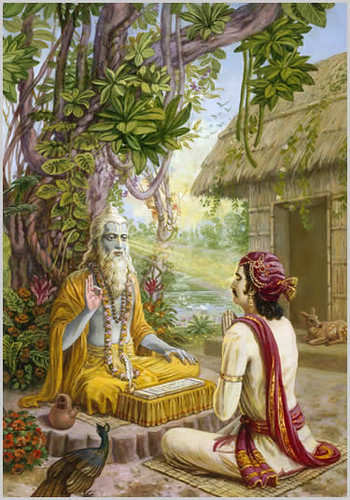
hear from the mouths of pure devotees who speak from the core of their hearts

SB 4.20.24

na kāmaye nātha tad apy ahaṁ kvacin
 na yatra yuṣmac-caraṇāmbujāsavaḥ
mahattamāntar-hṛdayān mukha-cyuto
 vidhatsva karṇāyutam eṣa me varaḥ

My dear Lord, I therefore do not wish to have the benediction of merging into Your existence, a benediction in which there is no existence of the nectarean beverage of Your lotus feet. I want the benediction of at least one million ears, for thus I may be able to hear about the glories of Your lotus feet from the mouths of Your pure devotees.

From the purport Text 24:
  1. Mahārāja Pṛthu wanted to have a million ears to hear the glories of the lotus feet of the Lord. He specifically mentioned that the glories of the Lord should emanate from the mouths of pure devotees, who speak from the cores of their hearts. It is stated in the beginning of Śrīmad-Bhāgavatam(1.1.3), śuka-mukhād amṛta-drava-saṁyutam: the nectar of Śrīmad-Bhāgavatam became more relishable because it emanated from the mouth of Śrīla Śukadeva Gosvāmī. 
  2. One might think that these glories of the Lord can be heard from anywhere, from the mouths of either devotees or nondevotees, but here it is specifically mentioned that the glories of the Lord must emanate from the mouths of pure devotees. 
  3. The words satāṁ prasaṅgān mama vīrya-saṁvidaḥ (Bhāg. 3.25.25) mean that glorification of the Lord is potent when uttered from the mouth of a pure devotee. 


From the purport Text 25:

  1. The transcendental vibration from the mouth of a pure devotee is so powerful that it can revive the living entity’s memory of his eternal relationship with the Supreme Personality of Godhead.
  2. The Lord asks every sleeping living entity to get up and engage in devotional service so that his mission in this human form of life may be fulfilled. This awakening voice comes through the mouth of a pure devotee.
  3. A pure devotee always engages in the service of the Lord, taking shelter of His lotus feet, and therefore he has a direct connection with the saffron mercy-particles that are strewn over the lotus feet of the Lord. Although when a pure devotee speaks the articulation of his voice may resemble the sound of this material sky, the voice is spiritually very powerful because it touches the particles of saffron dust on the lotus feet of the Lord. 
  4. As soon as a sleeping living entity hears the powerful voice emanating from the mouth of a pure devotee, he immediately remembers his eternal relationship with the Lord, although up until that moment he had forgotten everything.



Friday, August 7, 2015

The destination of those who accept money or personal service in return of sharing Bhagavatam

SB 4.12.49-50


Persons who have completely taken shelter of the lotus feet of the Lord should recite this narration of Dhruva Mahārāja without taking remuneration. Specifically, recitation is recommended on the full-moon or dark-moon day, on the day after Ekādaśī, on the appearance of the Śravaṇa star, at the end of a particular tithi, or the occasion of Vyatīpāta, at the end of the month, or on Sunday. Such recitation should of course be performed before a favorable audience. When recitation is performed this way, without professional motive, the reciter and audience become perfect.
Purport: 
Professional reciters may ask money to extinguish the blazing fire within their bellies, but they cannot make any spiritual improvement or become perfect. It is therefore strictly forbidden to recite Śrīmad-Bhāgavatam as a profession to earn a livelihood. Only one who is completely surrendered at the lotus feet of the Supreme Personality of Godhead, depending fully on Him for personal maintenance or even for maintenance of his family, can attain perfection by recitation of Śrīmad-Bhāgavatam, which is full of narrations of the pastimes of the Lord and His devotees. The process can be summarized as follows: the audience must be faithfully receptive to theBhāgavata message, and the reciter should completely depend on the Supreme Personality of Godhead. Bhāgavatarecitation must not be a business. If done in the right way, not only does the reciter achieve perfect satisfaction, but the Lord also is very satisfied with the reciter and the audience, and thus both are liberated from material bondage simply by the process of hearing.

Importance of hearing in a Society of Twice Borns

SB 4.12.48

The great sage Maitreya recommended: One should chant of the character and activities of Dhruva Mahārāja both in the morning and in the evening, with great attention and care, in a society of brāhmaṇas or other twice-born persons.

From Srila Prabhupada's purport:
It is said that only in the association of devotees can one understand the importance of the character and pastimes of the Supreme Personality of Godhead or His devotees. In this verse it is especially recommended that Dhruva Mahārāja’s character be discussed in a society of the twice-born, which refers to the qualified brāhmaṇas, kṣatriyasand vaiśyas. One should especially seek the society of brāhmaṇas who are elevated to the position of Vaiṣṇavas. Thus discussion of Śrīmad-Bhāgavatam, which describes the character and pastimes of devotees and the Lord, is very quickly effective. The International Society for Krishna Consciousness has been organized for this purpose. In every center of this Society — not only in the morning, evening or noon, but practically twenty-four hours a day — there is continuous devotional service going on. Anyone who comes in contact with the Society automatically becomes a devotee. We have actual experience that many karmīs and others come to the Society and find a very pleasing and peaceful atmosphere in the temples of ISKCON. 
and 
Srila Prabhupada also explains this in the verse describing who can Back to Godhead in SB 4.12:
A devotee is equipoised. He sees everyone on the same transcendental platform. A devotee knows that although a conditioned soul has a particular type of body according to his past fruitive activities, factually everyone is part of the Supreme Lord. A devotee sees all living entities with spiritual vision and does not discriminate on the platform of the bodily concept of life. Such qualities develop only in the association of devotees. Without the association of devotees, one cannot advance in Kṛṣṇa consciousness. Therefore, we have established the International Society for Krishna Consciousness. Factually, whoever lives in this society automatically develops Kṛṣṇa consciousness. Devotees are dear to the Supreme Personality of Godhead, and the Supreme Personality of Godhead is only dear to devotees. On this platform only can one make progress in Kṛṣṇa consciousness. Persons in Kṛṣṇa consciousness, or devotees of the Lord, can please everyone, as is evident in the Kṛṣṇa consciousness movement.

Thursday, March 12, 2015

Analogies Saunaka Rsi uses to condemn those averse to devotional service


1.     Do the trees not live
1.    Saunaka Rsi compares the long lives that the materialists aspire for with the long lives the trees live. A prolonged life without any devotional service is useless as Sankaracarya lived for 32 years and Lord Caitanya was on this planet for 48 years, on the other hand a materialist may try everything to prolong his life but his life is useless as it is not used for devotional service.
2.    do the beasts not eat and discharge semen?
1.    Saunaka Rsi indicates that persons who are simply engaged in planning a better type of animal life consisting of eating, breathing and mating are also animals in the shape of human beings. A society of such polished animals cannot benefit suffering humanity, for an animal can easily harm another animal but rarely do good.
3.    Men who are like dogs, hogs, camels and asses praise those men who never listen to the transcendental pastimes of Lord Sri Krsna, the deliverer from evils 
1.    As dogs are negligible animals and serve the master faithfully for bits of bread, a man serves a master faithfully without sufficient rewards. 
2.    Persons who have no discrimination in the matter of foodstuff and who eat all sorts of rubbish are compared to hogs. Hogs are very much attached to eating stools.
3.     The camel also sucks its own blood while chewing thorny twigs. The thorns the camel eats cut the tongue of the camel, and so blood begins to flow within the camel’s mouth. The thorns, mixed with fresh blood, create a taste for the foolish camel, and so he enjoys the thorn-eating business with false pleasure.
4.     Similarly, the great business magnates, industrialists who work very hard to earn money by different ways and questionable means, eat the thorny results of their actions mixed with their own blood.
5.     The central point of attraction for material enjoyment is sex life. To enjoy sex life is to suck one’s own blood. The ass works very hard and carries burdens of the maximum weight without making profit for itself.* When the ass begs for sexual intercourse, he is kicked by the fair sex, yet he still follows the female for such sexual pleasure. 
6.    The laborers in great factories and workshops are also engaged in such burdensome work, and after working hard during the day, the poor laborer has to be again kicked by the fair sex, not only for sex enjoyment but also for so many household affairs. In other words, such godless leaders of dogs and hoglike men are bigger animals with the qualities of animals in greater proportion.
4.    earholes like the holes of snakes, tongue like the tongue of a frog.
1.    If the tongue is not engaged in chanting the glories of the Lord then it is considered like the croaking of the frog because such a tongue is just engaged in speaking nonsense which has no value in one’s spiritual advancement for the speaker and the receiver.
2.     If the ear is not engaged in hearing about the Lord then the ears are to be considered like the holes of the snakes. Rats and mice make holes in agricultural fields; however the snakes eat the rat and mouse and live in those holes. Similarly if the ear is not used to hear the message of the Lord, then they are not being utilized properly. the senses and the action of the senses are to be considered impure or materialistic as long as they are employed only in sense gratification.
5.    Head crowned with a heavy silk turban.
1.    The common man who is puffed up with his material position and does not bow down before the Deity of the Lord in the temple, or who defies temple worship without any knowledge of the science, must know that his so-called turban or crown will only succeed in further drowning him in the water of the ocean of material existence. A drowning man with a heavy weight on his head is sure to go down more swiftly than those who have no heavy weight. 
2.    A foolish, puffed-up man defies the science of God and says that God has no meaning for him, but when he is in the grip of God’s law and is caught by some disease like cerebral thrombosis, that godless man sinks into the ocean of nescience by the weight of his material acquisition. 
3.    Advancement of material science without God consciousness is a heavy load on the head of human society, and so one must take heed of this great warning.

Saturday, April 12, 2014

What is the meaning of taking shelter of the Lord's Lotus Feet?

I heard this in a class by HG Vraja bihari Prabhu sometime in 2011 maybe:


What is the meaning of taking shelter of the Lord's Lotus Feet?

  • Physical Darshan
  • Humility, want to serve Krsna, become a servant of Krsna and His devotees. Take a humble position. Follow instructions
What is the qualification to take darshan of His Lotus Feet?
  • Attachment to hearing and Chanting about Krsna
  • Non enviousness
  • Hold on to the Holy Name - Kaliya was envious but by allowing Krsna to dance on his head all his dirty poison came out. Similarly if we hold on to the Lord;s Holy Name we will be cured of our envy.
How to meditate on Krsna's Lotus Feet?
  • Take Darshan step by step from His Lotus Feet progressively upwards finally to His face.
  • Follow the instructions of the spiritual master.


Thursday, April 18, 2013

Qualifications of a representative of Srila Vyasadeva 1.1.4- 1.1.8, 10.1.4

From verses and purport to 1.1.4 to 1.1.8


Character
  1. A gosvāmī, or the bona fide representative of Śrī Vyāsadeva, must be free from all kinds of vices before he can dare sit on the vyāsāsana. The four major vices of Kali-yuga are (a) illicit connection with women, (b) animal slaughter, (c) intoxication, (d) speculative gambling of all sorts. 
  2. He should be spotless in character.
  3. He should be very much obedient and (snighdha)submissive to his bona fide spiritual master and always ready to satisfy his spiritual master. 
  4. Saumya- pure and simple
Scriptural understanding
  1. He should be able to hear and explain them, which is more important than just reading them.
  2. Good hearing and chanting by which the real meaning of scripture awakens in the heart.
  3. Follows sincerely, is convinced and can therefore explain sincerely 
  4. He should be conversant in all systems of philosophy, namely Gautama, Kaṇāda, Kapila, Patañjali, Jaimini and Aṣṭāvakra so that he can present fully the theistic views of the Bhāgavatam in defiance of all other systems. 
  5. They must be in the disciplic succession
How he receives the message?
  1. Respect for the speaker 
  2. Asks questions with the intention of applying - this means submission and respect for the teacher
  3. Always in the mood of being a disciple- always trying to follow. A good leader is a good follower  
Some points from 10.1.4

Qualifications of speaker and receiver:
  1. A devotee is one who has no other motive for reciting Bhagavad-gītā and Śrīmad-Bhāgavatamthan to serve the Lord.
  2. Śukadeva Gosvāmī epitomizes the proper reciter for Śrīmad-Bhāgavatam, and Parīkṣit Mahārāja, who purposefully left his kingdom and family prior to meeting death, epitomizes the person fit to hear it. A qualified reciter of Śrīmad-Bhāgavatam gives the right medicine (bhavauṣadhi) for the conditioned souls. 
  3.  A Vaiṣṇava is nivṛtta-tṛṣṇa; that is, he has no material purpose, for his only purpose is to preach Kṛṣṇa consciousness
  4. The word paśu-ghnāt is important in this connection. Paśu-ghna means “butcher.” Persons fond of performing ritualistic ceremonies for elevation to the higher planetary systems must offer sacrifices (yajñas) by killing animals. Butchers cannot be interested in Kṛṣṇa consciousness, for they are already materially allured. 
  5. Anyone who is not Kṛṣṇa conscious and who therefore does not engage in the service of the Lord is also paśu-ghna, for he is willingly drinking poison.
  6. For kṛṣṇa-kathā, topics about Kṛṣṇa consciousness, there must be a speaker and a hearer, both of whom can be interested in Kṛṣṇa consciousness if they are no longer interested in material topics.
  7. For topics concerning Uttamaśloka, the Supreme Personality of Godhead, the spiritual master speaks, and the disciple hears with attention. Unless both of them are free from material desires, they cannot be interested in topics of Kṛṣṇa consciousness.
  8. The spiritual master and disciple do not need to understand anything more than Kṛṣṇa because simply by understanding Kṛṣṇa and talking about Kṛṣṇa, one becomes a perfectly learned person (yasmin vijñāte sarvam evaṁ vijñātaṁ bhavati, Muṇḍaka Upaniṣad 1.3).

Saranagati the 6 limbs of surrender in Gaudiya Vaishnavism

  Saranagati (total surrender or taking refuge in the Supreme Lord) in the Vaishnava tradition consists of six limbs , known as shadaanga-s...