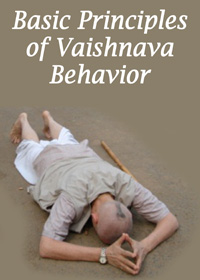
- SB 4.8.28: My dear Dhruva, if you feel that your sense of honor has been insulted, you still have no cause for dissatisfaction. This kind of dissatisfaction is another feature of the illusory energy; every living entity is controlled by his previous actions, and therefore there are different varieties of life for enjoying or suffering.
- Purport 4.8.28: Nārada Ṛṣi first of all wanted to impress upon Dhruva Mahārāja that he was only a child; he should not have been affected by words of insult or honor. And if he were so developed as to understand honor and insult, then this understanding should have been applied in his own life. He should have known that honor and dishonor are both destined only by one’s previous actions; therefore one should not be sorry or happy under any circumstances.
- Purport 4.8.27: Ordinarily if a child is rebuked as a rascal or fool, he smiles and does not take such insulting words very seriously. Similarly, if words of honor are offered, he does not appreciate them. But in the case of Dhruva Mahārāja, the kṣatriyaspirit was so strong that he could not tolerate a slight insult from his stepmother which injured his kṣatriya prestige.
- Purport 4.8.29 Essence:
- Everyone who is intelligent should know that because of our concept of bodily existence, we are subjected to suffering and enjoyment. One who is in the transcendental position, beyond the concept of bodily life, is considered to be intelligent.
- SB 4.8.33: "One should try to keep himself satisfied in any condition of life — whether distress or happiness — which is offered by the supreme will. A person who endures in this way is able to cross over the darkness of nescience very easily."
- Purport 4.8.33: Instead of being attached to the circumstantial happiness and distress resulting from pious or impious activities, if we want to get out of the clutches of this nescience, then whatever position we are put in by the will of the Lord we should accept. Thus if we simply surrender unto the Supreme Personality of Godhead, we shall get out of the clutches of this material existence.
- SB 4.8.34: Every man should act like this: when he meets a person more qualified than himself, he should be very pleased; when he meets someone less qualified than himself, he should be compassionate toward him; and when he meets someone equal to himself, he should make friendship with him. In this way one is never affected by the threefold miseries of this material world.
- Purport: Generally when we find someone more qualified than ourselves, we become envious of him; when we find someone less qualified, we deride him; and when we find someone equal we become very proud of our activities. These are the causes of all material tribulations.
- The great sage Nārada therefore advised that a devotee should act perfectly. Instead of being envious of a more qualified man, one should be jolly to receive him.
- Instead of being oppressive to a less qualified man, one should be compassionate toward him just to raise him to the proper standard.
- And when one meets an equal, instead of being proud of one’s own activities before him, one should treat him as a friend.
- One should also have compassion for the people in general, who are suffering due to forgetfulness of Kṛṣṇa. These important functions will make one happy within this material world.
Reading from the ripened fruit of all Vedic Literature - Granthraj Srimad Bhagavatam is very enriching to the lives of all devotees
Sunday, June 29, 2014
Vaishnava Dealings: How to never be affected by the three fold miseries of the world
When Narada Muni sees Dhruva feeling insulted by the sharp words of his step mother, he instructs him in the aspect of tolerance and relationships in the following way:
Friday, June 27, 2014
Forgiveness: The Ornament of a Vaishnava
SB 4.6.48 :My dear lord, if in some places materialists, who are already bewildered by the insurmountable illusory energy of the Supreme Godhead, sometimes commit offenses, a saintly person, with compassion, does not take this seriously. Knowing that they commit offenses because they are overpowered by the illusory energy, he does not show his prowess to counteract them.
- It is said that the beauty of a tapasvī, or saintly person, is forgiveness.
- A Vaiṣṇava is personally tolerant for the benefit of others. When he does not show his prowess, this does not mean that he is lacking in strength; rather, it indicates that he is tolerant for the welfare of the entire human society.
SB 4.6.49 :My dear lord, you are never bewildered by the formidable influence of the illusory energy of the Supreme Personality of Godhead. Therefore you are omniscient and should be merciful and compassionate toward those who are bewildered by the same illusory energy and are very much attached to fruitive activities.
- A Vaiṣṇava is never bewildered by the influence of the external energy because he is engaged in the transcendental loving service of the Lord.
- A Vaiṣṇava should take care of those who are bewildered by this māyā instead of becoming angry with them, because without a Vaiṣṇava’s mercy they have no way to get out of the clutches of māyā. Those who have been condemned by māyā are rescued by the mercy of devotees:
Wednesday, June 25, 2014
Ten topics of Srimad Bhagavatam
From Hg Gauranga Prabhu's lecture:
Sthanam:
3rd topic of SB.
Sthanam:
3rd topic of SB.
- Defn: sthitir vikuntha vijaya- right situation for the jivas to obey the laws of the Lord. Original creator and maintainer is Lord Vishnu. Creation comes into being it is the duty of the jivas to acknowledge the victory of the Lord in all situations.
- It means- soul has desires- sthanam means when the soul starts desiring to perform activities which will take him back to Godhead- the right position, the Lord is always protecting His devotees- sthitih- this protection of the Lord for His devotees is vaikuntha vijayah - that means the excellences/vijayah of the Lord of Vaikuntha. That means every jiva in the material world has to ultimately go to the spiritual world- how he will go is only based on the help which the Lord provides.
- vaikuntha vijay :means the Lord destroys the sufferings of the jivas . So the Lord is always wanting to protect the jivas in different ways - 3,4,5 cantos this aspect is highlighted of sthanam- protection which is offered by the Lord- if we simply express a desire to the Lord the Lord can offer appropriate protection.
- 3rd canto Kapila explains Bhakti in the modes of goodness, passion and ignorance. Based on that 4th canto first pastime- daksha prajapati second pastime is Dhruva third is Prthu . What the Lord can give no one can give(Dhruva Maharaja's pastime)
Tuesday, April 29, 2014
How Krishna sees Racists and those who possess a differential outlook ?
As the blazing fire of death, I cause great fear to whoever makes the least discrimination between himself and other living entities because of a differential outlook.
Purport:
There are bodily differentiations among all varieties of living entities, but a devotee should not distinguish between one living entity and another on such a basis; a devotee’s outlook should be that both the soul and Supersoul are equally present in all varieties of living entities.
Also Brahma says this to Lord Shiva in SB 4.6.47:
Persons who observe everything with differentiation, who are simply attached to fruitive activities, who are mean-minded, who are always pained to see the flourishing condition of others and who thus give distress to them by uttering harsh and piercing words have already been killed by providence. Thus there is no need for them to be killed again by an exalted personality like you.
Also Brahma says this to Lord Shiva in SB 4.6.47:
Persons who observe everything with differentiation, who are simply attached to fruitive activities, who are mean-minded, who are always pained to see the flourishing condition of others and who thus give distress to them by uttering harsh and piercing words have already been killed by providence. Thus there is no need for them to be killed again by an exalted personality like you.
Persons who are materialistic and always engaged in fruitive activities for material profit cannot endure seeing the flourishing life of others. Except for a few persons in Kṛṣṇa consciousness, the entire world is full of such envious persons, who are perpetually full of anxieties because they are attached to the material body and are without self-realization. Since their hearts are always filled with anxiety, it is understood that they have already been killed by providence. Thus Lord Śiva, as a self-realized Vaiṣṇava, was advised not to kill Dakṣa. A Vaiṣṇava is described aspara-duḥkha-duḥkhī because although he is never distressed in any condition of life, he is distressed to see others in a distressed condition. Vaiṣṇavas, therefore, should not try to kill by any action of the body or mind but should try to revive the Kṛṣṇa consciousness of others out of compassion for them. The Kṛṣṇa consciousness movement has been started to deliver the envious persons of the world from the clutches of māyā, and even though devotees are sometimes put into trouble, they push on the Kṛṣṇa consciousness movement in all tolerance. Lord Caitanya advises:
tṛṇād api sunīcena
taror api sahiṣṇunā
amāninā mānadena
kīrtanīyaḥ sadā hariḥ
taror api sahiṣṇunā
amāninā mānadena
kīrtanīyaḥ sadā hariḥ
“One can chant the holy name of the Lord in a humble state of mind, thinking himself lower than the straw in the street. One should be more tolerant than the tree, devoid of all sense of false prestige and ready to offer all respects to others. In such a state of mind one can chant the holy name of the Lord constantly.” (Śikṣāṣṭaka 3)
A Vaiṣṇava should follow the examples of such Vaiṣṇavas as Haridāsa Ṭhākura, Nityānanda Prabhu and also Lord Jesus Christ. There is no need to kill anyone who has already been killed. But it should be noted herewith that a Vaiṣṇava should not tolerate the blaspheming of Viṣṇu or Vaiṣṇavas, although he should tolerate personal insults to himself.
Saturday, April 12, 2014
The Lord's Darshan makes one aloof from sex attraction and one desires to see nothing else but the Lord
From the purport to SB 3.28.32:
A yogī should similarly meditate on the most benevolent smile of Lord Śrī Hari, a smile which, for all those who bow to Him, dries away the ocean of tears caused by intense grief. The yogī should also meditate on the Lord’s arched eyebrows, which are manifested by His internal potency in order to charm the sex-god for the good of the sages.
Purport:
It is stated in this verse that the charming eyebrows of the Lord are so fascinating that they cause one to forget the charms of sense attraction. The conditioned souls are shackled to material existence because they are captivated by the charms of sense gratification, especially sex life. The sex-god is called Makara-dhvaja. The charming brows of the Supreme Personality of Godhead protect the sages and devotees from being charmed by material lust and sex attraction. Yāmunācārya, a great ācārya, said that ever since he had seen the charming pastimes of the Lord, the charms of sex life had become abominable for him, and the mere thought of sex enjoyment would cause him to spit and turn his face. Thus if anyone wants to be aloof from sex attraction, he must see the charming smile and fascinating eyebrows of the Supreme Personality of Godhead.
3.28.33
With devotion steeped in love and affection, the yogī should meditate within the core of his heart upon the laughter of Lord Viṣṇu. The laughter of Viṣṇu is so captivating that it can be easily meditated upon. When the Supreme Lord is laughing, one can see His small teeth, which resemble jasmine buds rendered rosy by the splendor of His lips. Once devoting his mind to this, the yogī should no longer desire to see anything else.
Purport:
If the yogī is able to place the beautiful face of the Lord in the core of his heart, he will be completely satisfied. In other words, when one is absorbed in seeing the beauty of the Lord within himself, the material attraction can no longer disturb him.
3.28.33
With devotion steeped in love and affection, the yogī should meditate within the core of his heart upon the laughter of Lord Viṣṇu. The laughter of Viṣṇu is so captivating that it can be easily meditated upon. When the Supreme Lord is laughing, one can see His small teeth, which resemble jasmine buds rendered rosy by the splendor of His lips. Once devoting his mind to this, the yogī should no longer desire to see anything else.
Purport:
If the yogī is able to place the beautiful face of the Lord in the core of his heart, he will be completely satisfied. In other words, when one is absorbed in seeing the beauty of the Lord within himself, the material attraction can no longer disturb him.
What is the meaning of taking shelter of the Lord's Lotus Feet?
I heard this in a class by HG Vraja bihari Prabhu sometime in 2011 maybe:
What is the meaning of taking shelter of the Lord's Lotus Feet?
- Physical Darshan
- Humility, want to serve Krsna, become a servant of Krsna and His devotees. Take a humble position. Follow instructions
What is the qualification to take darshan of His Lotus Feet?
- Attachment to hearing and Chanting about Krsna
- Non enviousness
- Hold on to the Holy Name - Kaliya was envious but by allowing Krsna to dance on his head all his dirty poison came out. Similarly if we hold on to the Lord;s Holy Name we will be cured of our envy.
How to meditate on Krsna's Lotus Feet?
- Take Darshan step by step from His Lotus Feet progressively upwards finally to His face.
- Follow the instructions of the spiritual master.
Meditation on the Lord's Lotus Feet
From 3.28.1:
The devotee should first concentrate his mind on the Lord’s lotus feet, which are adorned with the marks of a thunderbolt, a goad, a banner and a lotus. The splendor of their beautiful ruby nails resembles the orb of the moon and dispels the thick gloom of one’s heart.
From the purport to the verse : 3.28.22
The blessed Lord Śiva becomes all the more blessed by bearing on his head the holy waters of the Ganges, which has its source in the water that washed the Lord’s lotus feet. The Lord’s feet act like thunderbolts hurled to shatter the mountain of sin stored in the mind of the meditating devotee. One should therefore meditate on the lotus feet of the Lord for a long time.
Purport:
The devotee should first concentrate his mind on the Lord’s lotus feet, which are adorned with the marks of a thunderbolt, a goad, a banner and a lotus. The splendor of their beautiful ruby nails resembles the orb of the moon and dispels the thick gloom of one’s heart.
From the purport to the verse : 3.28.22
The blessed Lord Śiva becomes all the more blessed by bearing on his head the holy waters of the Ganges, which has its source in the water that washed the Lord’s lotus feet. The Lord’s feet act like thunderbolts hurled to shatter the mountain of sin stored in the mind of the meditating devotee. One should therefore meditate on the lotus feet of the Lord for a long time.
Purport:
Another significant point of this verse is that the mind of the conditioned soul, on account of its association with the material energy from time immemorial, contains heaps of dirt in the form of desires to lord it over material nature. This dirt is like a mountain, but a mountain can be shattered when hit by a thunderbolt. Meditating on the lotus feet of the Lord acts like a thunderbolt on the mountain of dirt in the mind of the yogī. If a yogī wants to shatter the mountain of dirt in his mind, he should concentrate on the lotus feet of the Lord and not imagine something void or impersonal. Because the dirt has accumulated like a solid mountain, one must meditate on the lotus feet of the Lord for quite a long time. For one who is accustomed to thinking of the lotus feet of the Lord constantly, however, it is a different matter. The devotees are so fixed on the lotus feet of the Lord that they do not think of anything else. Those who practice the yoga system must meditate on the lotus feet of the Lord for a long time after following the regulative principles and thereby controlling the senses.
Subscribe to:
Posts (Atom)
Saranagati the 6 limbs of surrender in Gaudiya Vaishnavism
Saranagati (total surrender or taking refuge in the Supreme Lord) in the Vaishnava tradition consists of six limbs , known as shadaanga-s...
-
Om namah bhagavate vasudevaya I offer my obeisances to the Supreme Personality of Godhead, Vasudeva narayanam namaskritya naram...
-
Summary by HG Narayani Mataji: Verses 1-3: Mangalacarana Srimad Bhagavatam, the ripened fruit of the desire tree of the Vedas, glor...
-
1.8.22 namaḥ pańkaja - nābhāya namaḥ pańkaja - māline namaḥ pańkaja - netrāya namas te pańkajāńghraye My respectful obeisa...